
Freight Broker Insurance: Coverage, Bond Requirements, and Risk Protection for Brokerage Operations
A shipment delivers on time. The carrier leaves the facility. Hours later, emails begin circulating—an appointment window is disputed, paperwork doesn’t align, and multiple parties disagree about who is responsible.
For freight brokers, situations like this are not unusual.
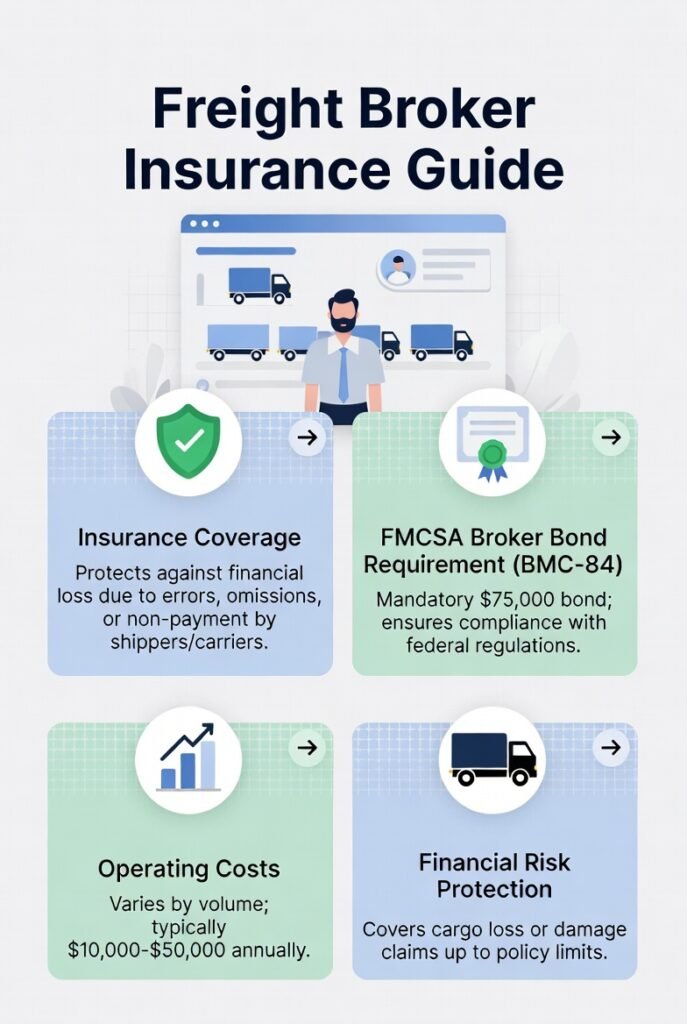
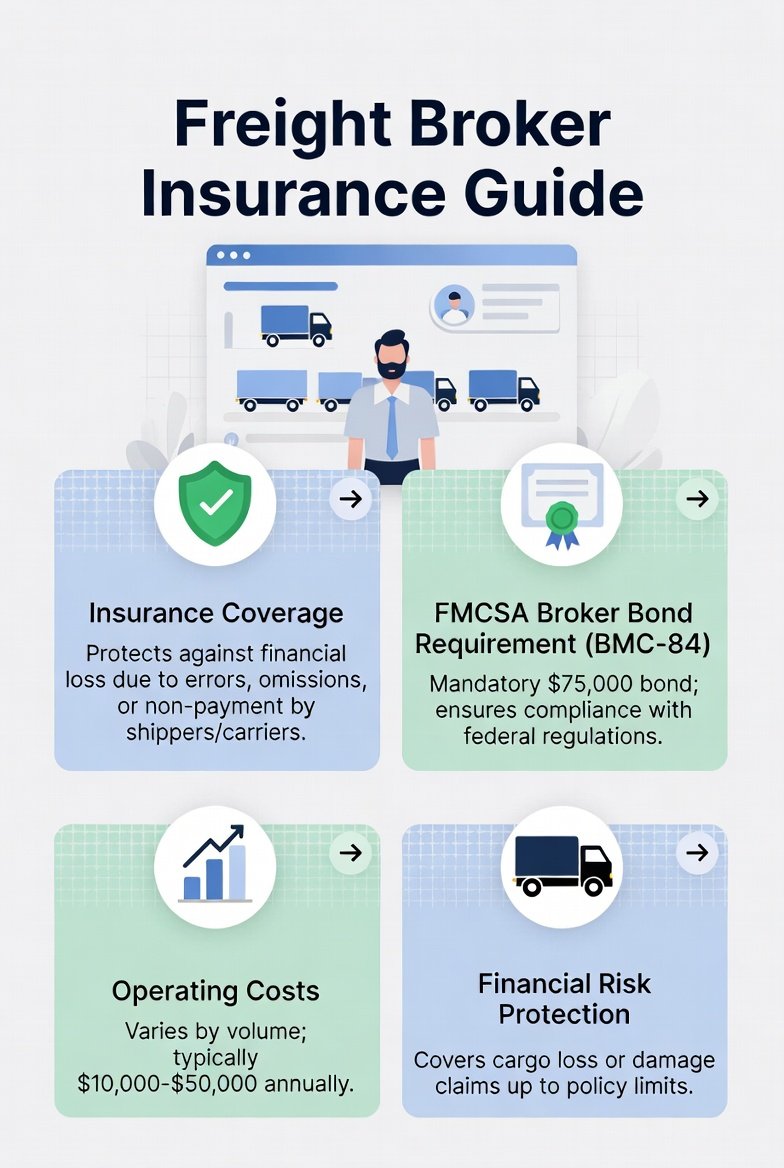
Freight broker insurance refers to the financial protections used by freight brokers to manage risks related to coordination, documentation, and contractual responsibility when arranging freight transportation between shippers and motor carriers.
Unlike trucking companies, freight brokers typically do not operate trucks or employ drivers. Their exposure arises from business coordination rather than vehicle operation.
Because brokers sit in the middle of the transaction chain, disputes frequently revolve around:
- communication errors
• documentation mismatches
• carrier verification issues
• service expectation disagreements
Understanding freight broker insurance requires recognizing how brokerage risk differs from the risks faced by motor carriers.
What Insurance Do Freight Brokers Need
Most freight brokers rely on several types of financial protection to manage operational risk.
The most common protections include:
Broker bond (BMC-84 or BMC-85)
A federally required financial security designed to protect motor carriers and shippers.
Errors and omissions insurance
Protects brokers from claims involving coordination mistakes, inaccurate information, or professional errors.
Contingent cargo insurance
Provides backup cargo protection if a carrier’s cargo insurance fails or denies coverage.
General liability insurance
Covers business risks unrelated to freight transportation such as office incidents or contractual disputes.
Larger brokerage firms may also carry additional protections such as cyber liability insurance to protect digital logistics systems.
These policies collectively help freight brokers manage the operational and financial risks associated with coordinating shipments.
Federal Freight Broker Bond Requirement (BMC-84 / BMC-85)
Freight brokers operating in the United States must comply with regulations established by the Federal Motor Carrier Safety Administration (FMCSA).
Before obtaining brokerage authority, brokers must maintain $75,000 in financial security.
This requirement can be satisfied through:
BMC-84 surety bond
The most common option, where brokers pay an annual premium to a surety provider rather than depositing the full amount.
BMC-85 trust fund
An alternative option requiring brokers to deposit the full $75,000 in a trust account.
The broker bond protects motor carriers and shippers when a broker fails to pay transportation charges or violates brokerage agreements.
Without this financial security requirement, brokers cannot legally operate as freight intermediaries in interstate commerce.
Why Freight Broker Risk Is Different From Motor Carrier Risk
Freight brokerage operations face a very different risk structure than trucking companies.
Motor carriers manage operational risks related to:
- truck accidents
• driver conduct
• cargo damage during transportation
Freight brokers face exposure tied to coordination responsibility and contractual agreements.
Key differences include:
Responsibility Without Physical Control
Freight brokers arrange transportation but do not operate vehicles.
Documentation-Driven Disputes
Claims often arise from communication breakdowns, incorrect load instructions, or mismatched paperwork.
Multi-Party Logistics Chains
A single shipment may involve several entities:
- shipper
• freight broker
• motor carrier
• warehouse operator
• third-party logistics provider
Because so many parties influence a shipment, disputes frequently focus on documentation and responsibility rather than accidents.
Motor carriers address operational risks through policies such as
Freight brokers instead rely on coverage designed to protect business coordination risk.

Freight Broker Insurance vs Motor Carrier Insurance
Role | Operational Responsibility | Primary Insurance Coverage |
Motor Carrier | Operates trucks and drivers | Liability, cargo, physical damage |
Freight Broker | Coordinates transportation | Errors & omissions, contingent cargo |
Hybrid Operations | Acts as both broker and carrier | Separate insurance programs |
Companies that operate as both brokers and carriers usually maintain separate insurance programs to ensure proper coverage.
Key Coverage Types for Freight Brokers
Freight broker insurance programs typically include several types of protection.
Errors and Omissions Insurance
Errors and omissions coverage protects brokers from allegations involving professional mistakes.
Examples include:
- assigning freight to an unqualified carrier
• providing incorrect shipment instructions
• failing to communicate delivery requirements properly
• documentation errors affecting transportation agreements
Because freight brokers coordinate shipments rather than transport them, many disputes revolve around professional liability rather than physical incidents.
Contingent Cargo Insurance
Contingent cargo insurance provides backup protection when a motor carrier’s cargo insurance fails.
Situations where contingent cargo may apply include:
- carrier cargo policy cancellation
• coverage exclusions within the carrier’s policy
• documentation errors affecting claim eligibility
While contingent cargo does not replace motor carrier cargo insurance, it can provide secondary protection for brokers facing cargo disputes.
More information on cargo protection can be found here:
General Liability Insurance
General liability insurance covers risks associated with business operations.
Examples include:
- visitor injuries at brokerage offices
• property damage involving business premises
• advertising liability disputes
Although these risks are unrelated to freight transportation itself, they remain standard protections for brokerage businesses.
How Freight Broker Insurance Claims Typically Occur
Freight brokerage disputes often follow a predictable sequence.
- A broker arranges transportation with a motor carrier
- The shipment experiences delays, damage, or documentation issues
- The shipper files a claim against the carrier
- The carrier’s insurance denies or limits coverage
- The shipper seeks financial recovery from the broker
Because freight brokers coordinate shipments without controlling vehicles, insurance claims often center on documentation practices and carrier verification procedures.
Typical Cost of Freight Broker Insurance
Insurance costs for freight brokers vary depending on operational factors such as experience, shipment volume, and credit profile.
Typical ranges include:
Broker bond premium
Most brokers pay between 1% and 4% of the $75,000 bond requirement annually, resulting in typical premiums between $750 and $3,000 per year.
Errors and omissions insurance
Policies for smaller brokerage firms typically range from $500 to $2,500 annually depending on policy limits.
Contingent cargo insurance
Policies often range from $400 to $1,500 annually depending on freight types and coverage limits.
General liability insurance
Small brokerage firms commonly pay between $300 and $1,000 annually.
Overall insurance costs for many freight broker operations fall between $2,000 and $6,000 per year depending on the structure of the brokerage.
How Freight Brokers Reduce Insurance Risk
Insurance provides financial protection, but operational discipline remains the most effective way to reduce disputes.
Many freight brokers implement structured procedures to minimize risk.
Common practices include:
- verifying carrier insurance before assigning shipments
• maintaining written broker-carrier agreements
• confirming cargo insurance limits for each load
• documenting shipment instructions clearly
• keeping communication records with shippers and carriers
These practices help clarify responsibility if disputes arise.
Additional guidance on trucking insurance structures can be found here:
How Freight Brokers Choose Insurance Providers
Freight brokers typically purchase insurance through agencies specializing in transportation risk.
When comparing providers, brokers often evaluate:
- coverage limits and exclusions
• contingent cargo triggers
• claims support and legal defense resources
• insurance agency experience with freight brokerage operations
Working with insurers familiar with transportation logistics often helps brokers obtain coverage that better matches their operational risk profile.
Final Perspective
Freight broker insurance is not designed to protect trucks—it is designed to protect coordination responsibility.
Freight brokers operate between shippers and motor carriers, where communication, documentation, and contractual obligations determine liability.
Because brokerage operations involve coordinating shipments across multiple parties, insurance coverage focuses on financial accountability, professional liability, and dispute resolution rather than road accidents.
Understanding how freight broker insurance works helps brokerage firms align their coverage with the realities of the logistics industry—an environment where documentation, timing, and communication often determine the outcome of disputes long after delivery occurs.