
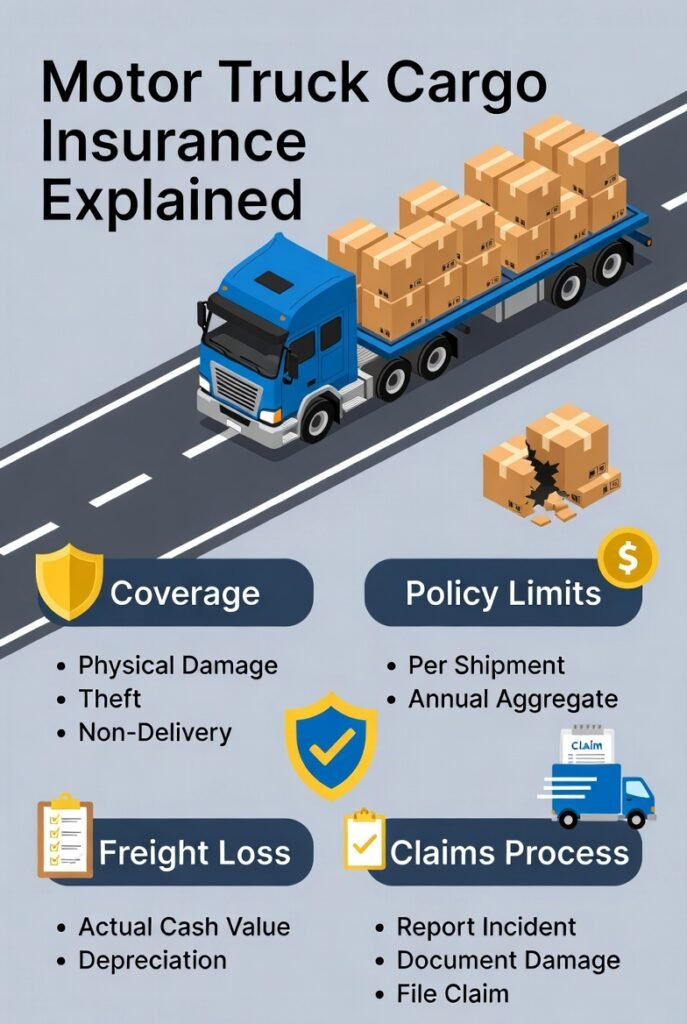
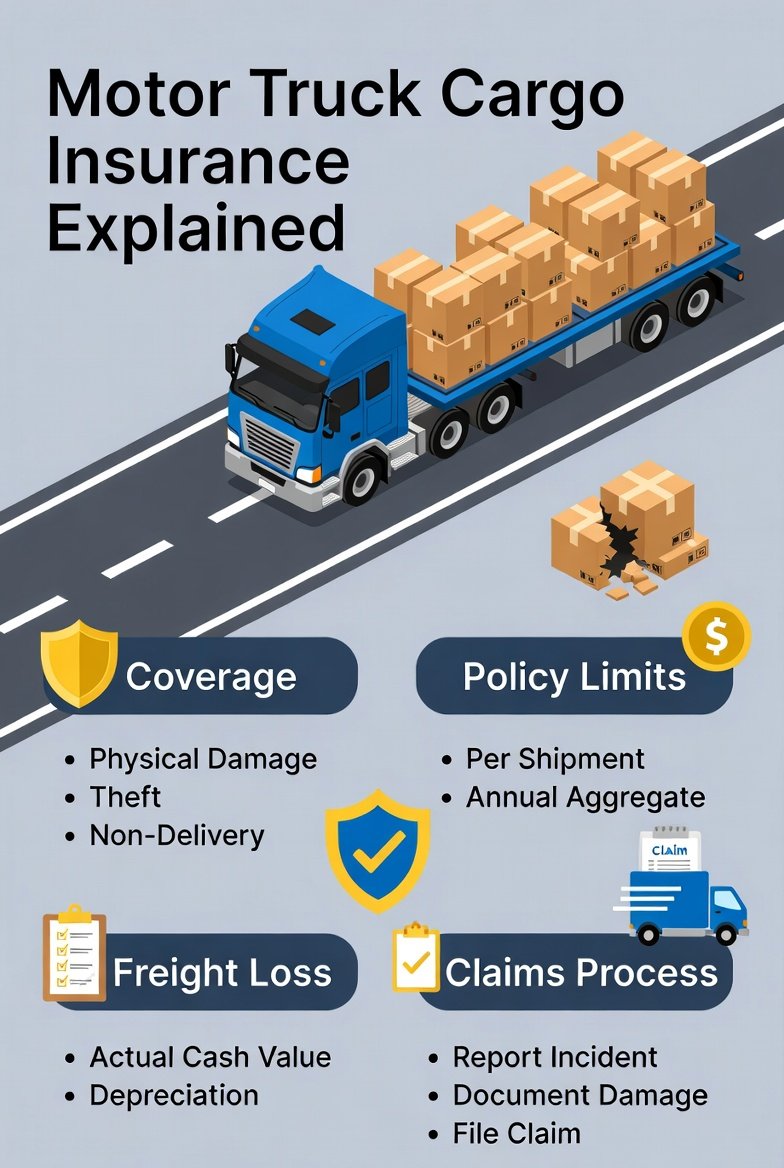
Motor Truck Cargo Insurance: Coverage, Limits, Claims & Freight Loss Explained
When the Trailer Is Sealed — but the Freight Is Rejected
The trailer doors open at the receiver.
There’s no accident report.
No visible collision.
The truck completed the route normally.
Yet the shipment is rejected.
Moisture damage appears inside sealed packaging. Pallets shifted during transit. Internal product damage becomes visible only after unloading.
Situations like this are one of the most common triggers for motor truck cargo insurance claims.
Freight loss rarely looks dramatic. It often develops quietly during transit through load movement, environmental exposure, or handling conditions that only become visible at delivery.
Motor truck cargo insurance exists to address these situations — protecting freight while it is in the carrier’s care, custody, and control during transport.
Understanding how this coverage works helps motor carriers manage the financial risk associated with moving goods for shippers and brokers.
What Motor Truck Cargo Insurance Is
Motor truck cargo insurance protects the value of freight being transported by a motor carrier if the cargo is lost, damaged, or stolen during transit.
The policy generally applies while freight is:
- loaded onto the trailer
- in transit between shipper and receiver
- temporarily stored during transport
- delivered and inspected at the destination
Cargo insurance focuses specifically on freight condition, not vehicle damage or injury liability.
That distinction matters because trucking operations usually require several different types of insurance.
For example:
- Cargo insurance protects the freight
- Liability insurance protects against accidents involving other people or property
- Physical damage insurance protects the truck itself
These policies typically operate together within broader trucking insurance programs such as
which addresses accident-related exposures for motor carriers.
Cargo coverage fills a different role: protecting the goods being transported.
Is Motor Truck Cargo Insurance Required
Motor truck cargo insurance is not always required by federal law for every carrier.
The Federal Motor Carrier Safety Administration (FMCSA) requires most motor carriers to carry public liability insurance, but cargo filings are typically required only for certain transportation categories such as household goods carriers.
However, even when cargo insurance is not federally mandated, it is often required in practice.
Many freight brokers and shippers require proof of cargo coverage before assigning loads. These contractual expectations frequently set minimum limits for freight protection.
For example, freight brokers coordinating shipments may require cargo coverage before working with carriers through broker agreements such as those discussed in
As a result, cargo insurance becomes a practical requirement of freight operations, even when regulatory filings are not mandatory.
Why Cargo Damage Happens Without Truck Accidents
Cargo claims often surprise new carriers because they rarely involve dramatic incidents.
Most freight damage develops during normal transportation conditions.
Load Movement
Freight can shift inside trailers due to braking, turns, or road vibration.
Even minor movement across long distances can compress packaging or destabilize pallets.
Continuous Vibration
Road vibration over long hauls can gradually damage fragile goods or loosen pallet structures.
Products packed tightly at pickup may shift slightly during transit.
Environmental Exposure
Changes in temperature and humidity may damage certain goods.
Examples include:
- condensation forming inside trailers
- heat affecting packaged goods
- moisture exposure during extended transit
Handling and Packaging Issues
Sometimes freight damage originates from packaging weaknesses that become visible only after transportation begins.
Because these issues develop gradually, determining when the damage occurred can require detailed documentation.
What Motor Truck Cargo Insurance Typically Covers
Motor truck cargo insurance generally responds to physical loss or damage to freight during transportation.
Typical covered scenarios may include:
Transit Damage
Freight damaged due to load shifting, impact within the trailer, or handling during transit.
Cargo Theft
Theft of freight while the truck is parked, stopped, or moving between destinations.
Fire or Collision Loss
Freight damaged due to vehicle accidents or fires involving the truck.
Concealed Damage
Damage discovered only after the shipment is unloaded and inspected by the receiver.
Cargo policies focus specifically on freight condition during transportation, rather than vehicle damage or injury liability.
What Motor Truck Cargo Insurance Often Does NOT Cover
Cargo insurance policies also contain exclusions.
Understanding these limitations is important because certain losses may fall outside standard coverage.
Common Exclusions | Explanation |
Improper packaging | Damage caused by inadequate packaging by the shipper |
Delay-related losses | Financial losses caused only by delivery delays |
Wear and tear | Gradual deterioration unrelated to transport conditions |
Certain commodities | Some high-risk goods require special endorsements |
Unattended vehicle restrictions | Theft conditions may apply when trucks are left unattended |
Because cargo policies vary between insurers, carriers should review coverage terms carefully.
How Much Motor Truck Cargo Insurance Carriers Need
Cargo coverage limits depend heavily on the value of the freight being transported.
Many freight brokers require at least $100,000 in cargo coverage, though higher-value shipments may require higher limits.
Typical coverage ranges may include:
Freight Type | Typical Coverage Range |
General freight | $100,000 |
Electronics or high-value cargo | $250,000 – $500,000 |
Specialized freight | $500,000+ depending on contract requirements |
The appropriate limit depends on several factors:
- average shipment value
- shipper contract requirements
- commodity type
- freight broker expectations
Higher-value goods often require larger limits because carriers may be responsible for freight damage during transport.
How Cargo Claims Are Investigated
Cargo claims typically rely heavily on documentation.
Unlike accident claims, there may be no crash report or police investigation to determine what happened.
Instead, insurers review records such as:
- bills of lading
- pickup and delivery inspection reports
- driver communication records
- cargo photographs
- freight documentation
Because cargo damage may appear only after unloading, these records help determine whether the damage occurred during transit or before the shipment was picked up.
Operational Practices That Reduce Cargo Claims
Insurance helps manage financial exposure, but operational discipline remains the most effective way to reduce cargo disputes.
Many carriers improve cargo outcomes by implementing consistent freight procedures.
Securement Standards
Using proper load bars, straps, and blocking methods prevents freight movement during transit.
Clear Cargo Documentation
Detailed cargo descriptions on bills of lading help clarify responsibility during disputes.
Pickup and Delivery Inspections
Drivers often inspect freight conditions at pickup and delivery to identify damage early.
Communication Between Parties
Maintaining clear communication between carriers, brokers, and shippers helps resolve problems before they escalate.
Freight coordination practices often intersect with broader transportation risk management frameworks such as those used by
truck-broker-insurance and logistics intermediaries managing carrier relationships.
Owner-Operators vs Fleet Cargo Exposure
Cargo exposure changes depending on the size of the trucking operation.
Owner-Operators
Single-truck operators often transport a narrower range of freight types.
Insurers typically evaluate:
- cargo consistency
- securement practices
- driver experience
Fleet Operations
Fleet carriers handle larger shipment volumes and multiple cargo types.
This can increase complexity because:
- multiple drivers operate under the same policy
- shipment values vary
- freight types may change frequently
Larger operations often review coverage periodically to ensure cargo limits match operational exposure.
Cargo protection also intersects with other transportation roles such as freight coordination and logistics dispatch, which may involve operational structures similar to those described in
When Motor Truck Cargo Insurance Should Be Reviewed
Cargo insurance should be reviewed periodically as trucking operations evolve.
Coverage reviews are often triggered by:
- transporting new freight types
- accepting higher-value shipments
- expanding service areas or routes
- increasing shipment volume
- entering new shipper or broker contracts
Insurance coverage that worked for a smaller operation may not reflect the risks of a growing trucking business.
How Cargo Insurance Fits into Trucking Insurance Programs
Motor truck cargo insurance typically works alongside several other trucking insurance policies.
Motor carriers commonly combine cargo coverage with:
- commercial-truck-insurance
- for accident liability protection
- physical-damage-insurance-trucking
- to protect the truck itself
- general liability coverage for business exposures
Each policy protects a different part of trucking operations.
Cargo insurance specifically focuses on the freight being transported, making it one of the most important protections for carriers moving goods on behalf of shippers.
Final Perspective
Motor truck cargo insurance addresses a key reality of freight transportation:
Most cargo losses do not involve dramatic accidents.
Instead, they emerge quietly through freight movement, packaging failure, environmental exposure, or documentation disputes that become visible only when shipments reach their destination.
Because these losses rarely involve collisions, successful cargo claim resolution often depends on documentation, securement practices, and clear freight handling procedures.
For motor carriers, understanding how cargo insurance works helps align operational practices with the coverage designed to protect the freight they move every day.