
Box Truck Insurance
Box truck insurance exists because delivery operations cannot pause.
Box trucks are not built for occasional hauling or long-distance freight. They are built for daily routes, fixed schedules, repeated stops, and constant interaction with customers, properties, and public spaces. When a box truck is down, the business behind it stalls immediately.
This is why box truck insurance is not simply “commercial truck insurance for smaller trucks.” It is a last-mile business protection structure designed around operational continuity, frequent exposure, and delivery-driven risk.
What Box Truck Insurance Actually Is
Box truck insurance refers to the insurance framework used for straight trucks and cube trucks operating in local and regional delivery roles.
What defines box truck insurance is not mileage or cargo weight.
It is defined by:
Daily route dependency
High stop counts
Repetitive loading and unloading
Urban and residential operation
Insurance must support business continuity, not just accident response.
Why Box Truck Insurance Is Fundamentally Different
Box truck operations experience operational risk before catastrophic risk.
Key structural differences include:
Frequent short trips instead of long hauls
Constant interaction with private property
Regular curbside and dock activity
Tight delivery windows
Losses often involve:
Property damage at delivery locations
Low-speed vehicle incidents
Pedestrian or cyclist involvement
Repeated minor claims rather than single major events
Insurance for box trucks must manage frequency and interruption, not just severity.
The Last-Mile Business Exposure Model
Box truck losses tend to originate from four delivery-specific exposure drivers.
Route Dependency Exposure
When a box truck is unavailable:
Routes collapse
Deliveries are missed
Customer trust is impacted
Insurance must support rapid recovery.
Stop-Driven Interaction Exposure
Each stop introduces:
Human interaction risk
Property proximity
Traffic interruption
Exposure compounds with delivery volume.
Loading & Unloading Exposure
Losses frequently occur during:
Dock alignment
Curbside unloadin
Lift-gate or ramp use
Many incidents occur off the roadway entirely.
Repetitive Maneuvering Exposure
Daily repetition increases:
Blind-spot incidents
Minor impacts
Structural contact losses
This exposure is persistent, not occasional.
Core Coverage Layers in Box Truck Insurance
Box dump truck insurance works best when viewed as operational protection, not just legal compliance.
Liability Coverage (Public Interaction Layer)
Liability coverage responds to injury or property damage caused by box truck operation.
For box trucks:
Claims often involve pedestrians or property
Urban settings complicate fault
Incidents are highly visible
This layer defines the operation’s external risk boundary.
Physical Damage Coverage (Operational Continuity Layer)
Physical damage coverage applies to damage to the truck itself.
For delivery operations, this coverage directly affects:
Route fulfillment
Repair turnaround time
Daily revenue stability
Even small incidents can interrupt operations.
Cargo Responsibility Coverage
Cargo coverage applies when goods are damaged or lost.
Exposure depends on:
Handling procedures
Control during loading/unloading
Nature of the goods
In delivery operations, cargo losses often occur outside of transit.
Downtime & Business Interruption Considerations
Box truck downtime creates immediate disruption:
Missed delivery windows
Contract strain
Route reassignment costs
Coverage intended to address downtime must be evaluated carefully for scope and limitations.
Why Box Truck Losses Behave Differently
Box truck losses differ from long-haul trucking in three ways:
Lower speeds but higher frequency
Greater proximity to people and property
Constant operational pressure
Insurance limits and deductibles must be evaluated through a frequency-driven, business-impact lens.
Box Truck Insurance vs Other Commercial Truck Insurance
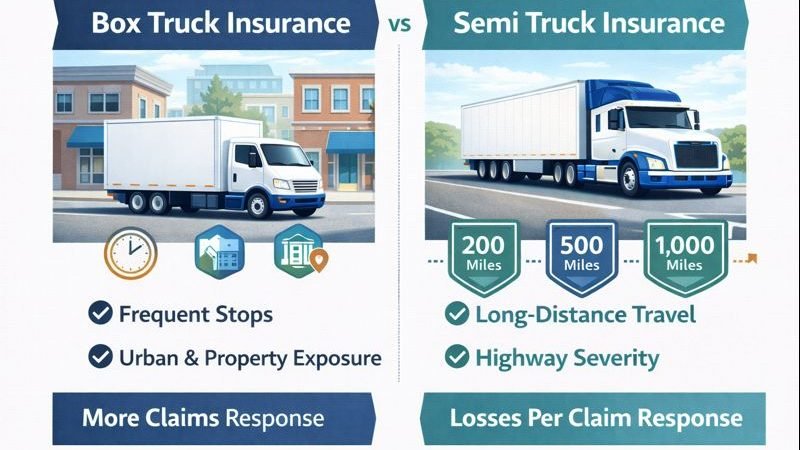
The distinction is operational.
Semi trucks manage distance-driven exposure
Dump trucks manage job-site exposure
Box trucks manage delivery-driven exposure
Applying long-haul insurance deductibles logic to last-mile delivery creates coverage gaps.
Common Coverage Gaps in Box Truck Insurance
Recurring issues include:
Loading and unloading exposure overlooked
Urban property damage underestimated
Deductibles misaligned with frequent claims
Coverage written for regional rather than local operations
These gaps usually appear through repeated small losses.
How Box Truck Insurance Evolves as Businesses Grow
Insurance needs shift as delivery operations scale.
Common changes include:
Expanded service areas
Higher delivery volume
More time-sensitive contracts
Fleet growth
Coverage structure should evolve with operational complexity.
How to Evaluate Box Truck Insurance coverage Structure
Before comparing providers or costs, consider:
How does insurance respond at delivery locations?
Are loading and unloading activities clearly addressed?
Do deductibles align with frequent, low-severity incidents?
These questions define structure before pricing enters the discussion.
FAQs
What is box truck insurance?
Box truck insurance is the insurance framework designed for straight trucks operating in local and last-mile delivery environments.
Is box truck insurance different from semi truck insurance?
Yes. Box truck insurance focuses on delivery frequency and urban exposure, while semi truck insurance focuses on long-haul highway risk.
Does box truck insurance cover delivery-related property damage?
Liability coverage may respond depending on responsibility and how the incident occurred.
Why are box truck claims more frequent?
Frequent stops, repeated maneuvering, and close interaction with people and property increase incident frequency.
Does box truck insurance need to change as delivery volume increases?
Yes. Higher delivery density and route expansion often require coverage adjustments.
Bottom Line
Box truck insurance exists because last-mile businesses rely on uninterrupted movement.
When insurance structure supports delivery density, frequent interaction, and operational continuity, it protects the business. When it does not, small interruptions accumulate into major disruption.
Understanding that structure comes before any cost or provider decision.