
Dump Truck Insurance
Most dump-truck losses do not begin on highways.
They begin on job sites.
Dump truck insurance exists because dump trucks operate in environments where responsibility is blurred, damage escalates quickly, and standard trucking assumptions stop working. Loading zones, uneven terrain, backing operations, dumping cycles, and close-quarters work introduce a level of exposure that standard commercial truck insurance does not adequately account for.
This is why dump truck insurance is not simply trucking insurance for a heavier vehicle. It is a specialized insurance structure built around construction environments, material handling, and weight-amplified loss severity.
What Dump Truck Insurance Actually Is
Dump truck insurance refers to the insurance framework designed for trucks that haul and unload bulk materials such as dirt, gravel, sand, asphalt, aggregate, or demolition debris.
What defines dump truck insurance is not mileage or route length.
It is defined by:
Extreme vehicle weight
Repetitive loading and unloading cycles
Off-road and job-site operation
Frequent proximity to workers and equipment
Insurance structure must reflect how dump trucks actually work, not how highway trucks are assumed to operate.
Why Dump Truck Insurance Is Structurally Different
Dump trucks face a risk profile that is both concentrated and high-severity.
Key structural differences include:
Regular off-road operation
Unstable or unfinished ground conditions
High center-of-gravity during dumping
Frequent backing and tight-space maneuvering
Losses commonly involve:
Tip-over incidents
Equipment strikes
Property damage on active job sites
Third-party injury in confined spaces
These losses escalate faster than typical highway incidents.
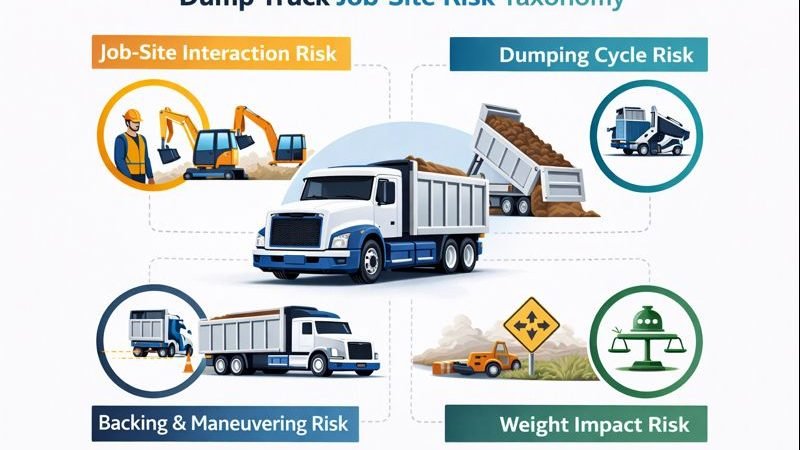
The Dump Truck Risk Taxonomy (Critical Framework)
All dump truck losses fall into four primary risk categories.
Understanding these categories is essential.
Job-Site Interaction Risk
Exposure created by operating near:
Workers
Excavators
Loaders
Temporary structures
Responsibility is often disputed in these environments.
Weight-Amplified Impact Risk
Extreme vehicle weight increases:
Braking distance
Damage severity
Injury outcome
Every collision is amplified by mass.
Dumping & Material Handling Risk
Risk created during:
Raising beds
Load release
Spillage or uneven dumping
Losses here often involve property or equipment damage.
Maneuvering & Backing Risk
Short-distance, repeated backing creates:
Blind-spot incidents
Equipment strikes
Worker injuries
This risk is persistent, not occasional.
The Role of Job-Site Exposure in Dump Truck Insurance
Job-site exposure is the defining factor in dump truck insurance coverage.
Unlike highway trucking:
Job sites involve multiple contractors
Responsibility may be shared or unclear
Damage may involve unfinished property
Insurance must respond where:
Fault is contested
Control shifts rapidly
Loss escalates before investigation is complete
Coverage that performs well on highways may behave unpredictably on job sites.
Core Coverage Layers in Owner operator Insurance
Dump truck insurance is best understood as layered risk protection.
Liability Coverage (Primary Exposure Layer)
Liability coverage addresses injury or property damage caused by dump truck operation.
For dump trucks, this layer is critical because:
Vehicle mass magnifies damage
Job-site claims involve multiple parties
Loss severity escalates quickly
Liability coverage defines the operation’s public risk boundary.
Physical Damage Coverage (Heavy-Equipment Protection)
Physical damage coverage applies to damage to the dump truck itself.
For dump truck operations, this coverage directly affects:
Repair timelines
Downtime duration
Cash-flow disruption
Heavy-duty components, hydraulics, and frames mean repairs are rarely simple.
Heavy-duty components, hydraulics, and frames mean repairs are rarely simple.
Material Handling & Load-Related Exposure
Dump trucks do not carry packaged cargo, but material handling creates its own exposure.
Losses may arise from:
Load spillage
Improper dumping
Structural damage from material release
Insurance responsibility depends on:
Operational control
Contract terms
Phase of operation
This exposure is often misunderstood.
Downtime & Income Interruption Considerations
Dump truck downtime is often more disruptive than long-haul downtime because:
Projects are time-bound
Replacement equipment may be unavailable
Idle crews compound losses
Coverage intended to address downtime must be evaluated carefully for trigger conditions and limitations.
Dump Truck Insurance and Weight-Driven Severity
Weight changes everything.
Higher gross vehicle weight affects:
Accident severity
Structural damage outcomes
Injury potential
Insurance limits, deductibles, and exclusions must be evaluated through a weight-amplified risk lens, not standard trucking assumptions.
Dump Truck Insurance cost vs Standard Truck Insurance
The difference is structural, not cosmetic.
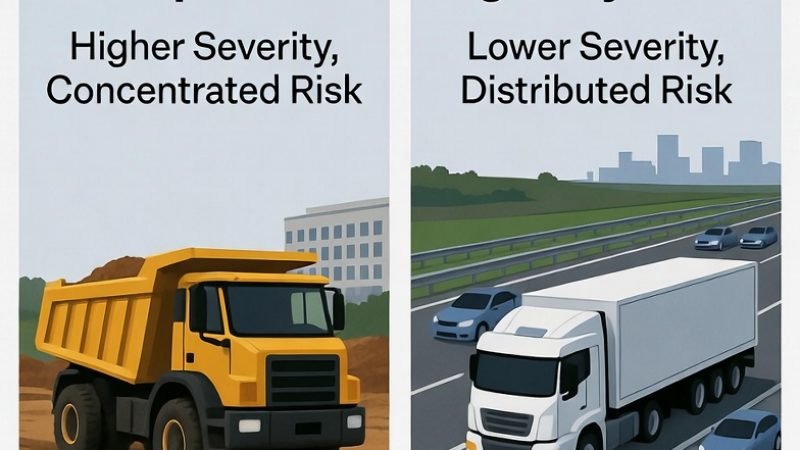
Highway trucks distribute risk over distance
Dump trucks concentrate risk on job sites
Highway incidents involve traffic
Dump truck incidents involve equipment and structures
Applying standard trucking insurance logic to dump truck operations creates coverage gaps.
Common Coverage Gaps in Dump Truck Insurance
Recurring issues include:
Job-site exposure underestimated
Dumping operations excluded or limited
Deductibles misaligned with heavy repairs
Coverage written for on-road use only
These gaps often surface only after a major loss.
How Dump Truck Insurance Evolves Over Time
Insurance needs change as operations grow.
Common inflection points include:
Larger contracts
Heavier loads
More complex job sites
Expanded operating areas
Coverage structure should be reviewed when these changes occur.
How to Evaluate Dump Truck Insurance Structure
Before comparing providers or costs, it helps to ask:
Where does responsibility sit during dumping and loading?
How does insurance respond on active job sites?
How do deductibles and limits align with heavy-duty repairs?
These questions define structure before pricing enters the discussion.
FAQs
What is dump truck insurance?
Dump truck insurance is the insurance framework designed for dump trucks operating in construction and material-handling environments with elevated risk.
Is dump truck insurance different from standard truck insurance?
Yes. Dump truck insurance accounts for job-site exposure, heavy loads, and high-severity losses.
Does dump truck insurance cover job-site damage?
Liability coverage may respond depending on control, responsibility, and how the loss occurred.
Why is weight such a big factor in dump truck insurance?
Vehicle weight amplifies damage, injury severity, and claim costs.
Does dump truck insurance need to change as operations grow?
Yes. Larger jobs and heavier loads often require coverage adjustments.
Bottom Line
Dump truck insurance deductibles because job-site work creates concentrated, high-severity risk.
When insurance structure reflects job-site reality, material handling exposure, and weight-driven severity, it provides stability. When it does not, losses escalate rapidly.
Understanding that structure is essential before engaging with cost or provider decisions.